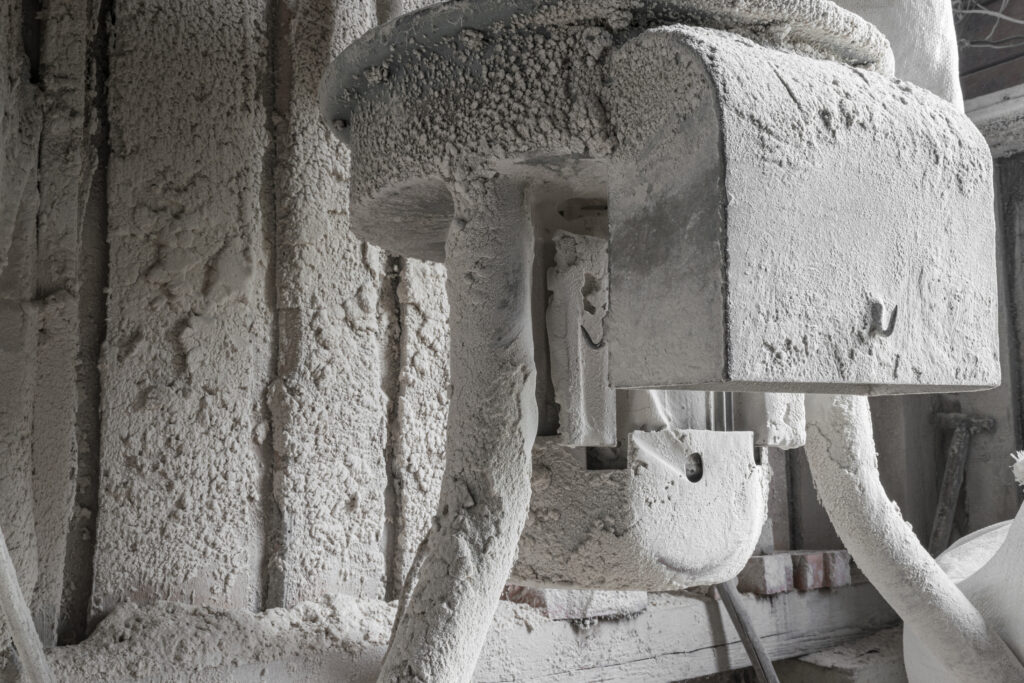
Fine particulate solids, or combustible dusts, pose an extreme safety risk in many industries. By the National Fire Protection Association’s (NFPA) definition, dusts can become combustible when any “finely divided solid material that is 420 microns or smaller in diameter” is suspended in the air. These dusts present a significant fire and explosion hazard when finely divided solid particles are generated during industrial processes such as grinding, conveying, cutting, mixing, or packaging. A recent report from DustEx Research [1] shows hundreds of global incidents each year. Between January 2023 and January 2024, dust hazards caused 263 fires, 53 explosions, 94 injuries, and 62 fatalities worldwide. Performing a systematic dust hazard analysis (DHA) can help prevent such catastrophes.
Combustible Dust Hazards
Dust particles can remain suspended in the air due to process turbulence or ventilation and may also settle on horizontal and elevated surfaces, including structural beams, ductwork, and equipment. Although these deposits may not be readily visible from ground level, they can become re-suspended into the air during routine operations or disturbances such as vibration, air movement, or maintenance activities.
A hazardous scenario develops when the airborne dust concentration reaches or exceeds the minimum explosible concentration (MEC), forming a combustible cloud capable of rapid flame propagation. Scientific studies have demonstrated that the increased surface-area-to-volume ratio of fine particles accelerates combustion kinetics, resulting in high flame speeds and pressure rise during deflagration [2,3]. If ignition occurs in a confined or semi-confined environment, pressure buildup can lead to structural failure and the dispersion of additional dust layers, resulting in secondary explosions that are often more destructive than the initiating event.
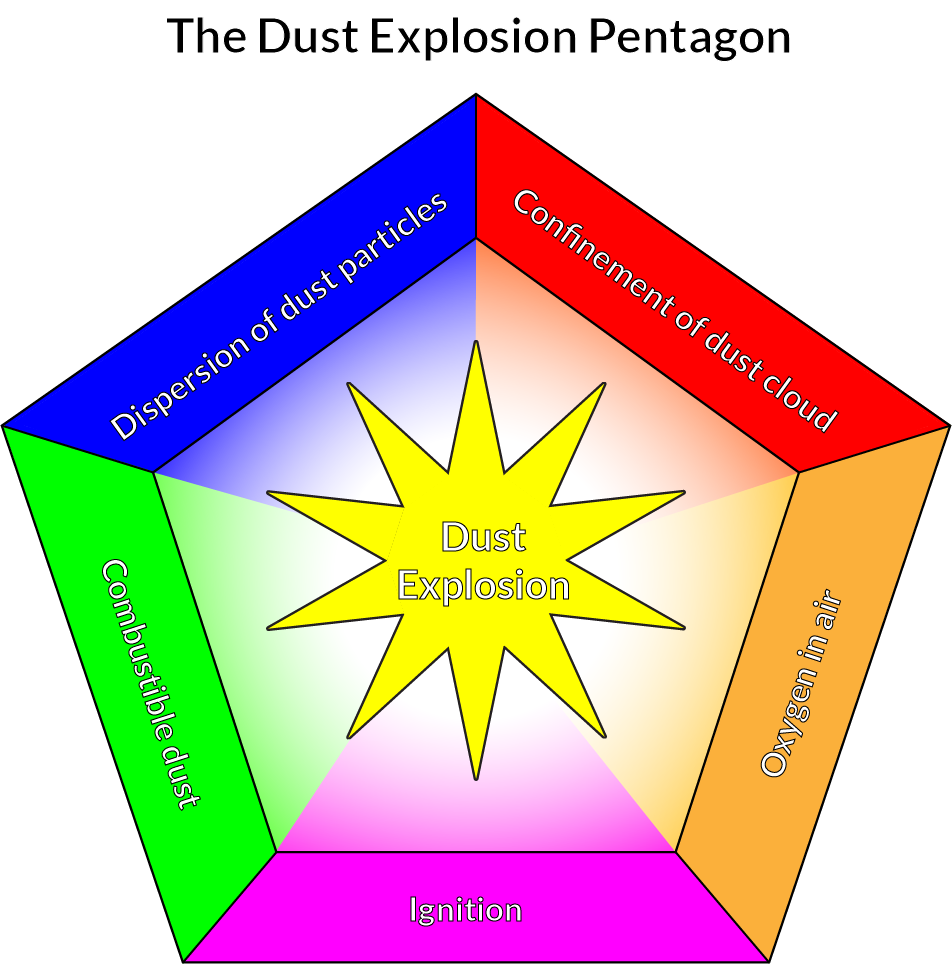
A combustible dust fire or explosion requires the simultaneous presence of five key elements, commonly referred to as the “dust explosion pentagon”:
-
Fuel (combustible dust)
-
An oxidizing atmosphere
-
Dispersion of dust into a cloud
-
Confinement
-
An ignition source
Even low-energy ignition sources such as electrostatic discharge, mechanical friction, overheated surfaces, or electrical faults have the potential to create combustion in dust clouds with low minimum ignition energy (MIE).
Dust Hazard Analysis
DHAs form the technical basis for prevention measures by
- examining process flows
- testing dust properties (e.g., explosibility, particle size)
- predicting worst-case scenarios
It is crucial to have a professional specialist perform a hazard analysis to identify risks and guide controls. DHAs are typically multidisciplinary, team-driven exercises, analogous to Process Hazard Analysis (PHA), but they are focused on particulate hazards.
Dust hazard analysis is a systematic review of processes that generate, store, or handle dust with the goal of identifying potential ignition sources, vulnerable locations, and control gaps.
The professional or team that performed the DHA can develop effective risk reduction strategies, such as
- preventing dust accumulation
- minimizing dispersion
- controlling ignition sources
- applying engineering safeguards, such as dust collection, explosion venting, isolation, and suppression
The Chemical Safety Board (CSB) emphasizes that dust hazard analyses, including dust-level measurement and testing, help overcome industry complacency and provide a basis for evaluating and designing effective control of the underlying hazard. Without a structured hazard analysis, hazardous conditions can be “normalized” until disaster strikes.
NFPA 660
In the United States, combustible dust safety has long been guided by multiple, industry-specific NFPA standards. However, NFPA 660: Standard for Combustible Dusts and Particulate Solids was published in December 2024, consolidating the combustible dust requirements into one unified code.
Standard Consolidation
NFPA 600 merges six legacy standards, including
- NFPA 61: Standard for the Prevention of Fires and Dust Explosions in Agricultural and Food Processing Facilities
- NFPA 484: Standard for Combustible Metals
- NFPA 652: Standard on the Fundamentals of Combustible Dust
- NFPA 654: Standard for the Prevention of Fire and Dust Explosions from the Manufacturing, Processing, and Handling of Combustible Particulate Solids
- NFPA 655: Standard for Prevention of Sulfur Fires and Explosions
- NFPA 664: Standard for the Prevention of Fires and Explosions in Wood Processing and Woodworking Facilities
The goal is to simplify compliance:
|
NFPA 660 Chapter |
Dust |
|
21 |
covers food/agriculture |
|
22 |
covers metalworking/additive manufacturing |
|
23 |
covers sulfur |
|
24 |
covers wood |
|
25 |
covers “other” industries, like pharmaceuticals |
NFPA 660 retains all fundamental requirements (housekeeping, testing, ventilation, etc.) while updating and clarifying language.
DHA Requirements
The new standard explicitly integrates DHA into its framework, offering a walkthrough on identifying combustible dust risks and performing a DHA. Effective DHAs quantify dust explosion parameters (KST – Dust Deflagration Index, PMAX – Max Explosion Pressure, Minimum Explosive Concentration, ignition energy, etc.) to characterize severity, and they rank process hazards by likelihood and consequence.
NFPA 660 explicitly includes guidance on
- Risk assessment and hazard identification, providing a walkthrough of testing materials, finding combustible-dust risks, and performing a DHA
- Preventive measures and controls, such as dust collection, explosion protection, isolation valves
- Housekeeping practices
- Training and emergency response planning
By following NFPA 660, facilities can create a formal roadmap to manage dust risks.
Summary of NFPA 660 Key Provisions
NFPA 660 introduces several crucial updates to strengthen hazard analysis and dust control:
- Dust Hazard Analysis: Continues the NFPA 652 requirement that all dust-handling facilities perform a DHA. NFPA 660 maintains the five-year revalidation cycle for DHAs. In other words, once a DHA is completed, it must be reviewed and updated every five years or after significant changes. This ensures dust risks are reevaluated on a fixed schedule.
- Dust Characterization and Testing: Emphasizes systematic dust property testing. NFPA 660 provides detailed guidance on sampling and analyzing dust. By unifying testing protocols, the standard ensures facilities gather critical quantitative data during the hazard analysis.
- Unified Definitions: Consolidates definitions across all dust types (organic, metal, etc.), reducing confusion in enforcement. This means terms like “combustible dust” and “measurement criteria” are standardized in one place.
- Program Management: Introduces stronger administrative requirements. Chapter 10 calls for written combustible dust management programs, documented inspections, maintenance records, and employee training. This shift focuses on continuous compliance, not just a one-time analysis.
- Housekeeping & Accumulation Limits: Continues to stress housekeeping. NFPA 660 sets thresholds for dust layer thickness and requires dust removal plans in hazardous areas. It explicitly prioritizes risk-based housekeeping; high-risk zones get more frequent cleaning.
- Interim Safeguards: A new provision requires facilities to install interim controls when full compliance cannot be immediately achieved. Rather than allowing operators to postpone safety upgrades, NFPA 660 mandates temporary measures to reduce risk during the transition to full compliance.
Combined, these provisions mean every industrial sector dealing with dust must integrate hazard analysis into ongoing operations, using DHA findings to select engineering controls (like explosion vents, suppression systems, or improved ventilation) and administrative safeguards.
Adoption
NFPA 660 is now the published “master” combustible-dust standard, but jurisdictions must still adopt it to be enforceable. Many jurisdictions currently reference NFPA 654, 652, and others, but NFPA 660 adoption may take several years; however, it should be referenced as a benchmark for compliance. Notably, OSHA’s combustible dust emphasis cites NFPA guidance, so updating facility programs to NFPA 660 aligns with U.S. regulations.
Global Perspective
High-profile dust explosions continue to occur globally, underscoring the need for diligent hazard analysis. For example, a 2021 explosion in Singapore killed three and injured seven, a January 2024 blast at a Chinese metal-processing plant killed eight and wounded eight, to name a few, and resulted from unaddressed dust hazards.
Compiling worldwide data highlights that dust events remain frequent: one industry survey reports an average of 28 U.S. dust explosions and ~25 injuries per year from 2016 to 2023 [1].
In Europe, combustible dust hazards are regulated under the ATEX (ATmosphères EXplosibles) Directives. At the same time, the United Kingdom enforces similar safety obligations through the DSEAR (Dangerous Substances and Explosive Atmospheres Regulations) framework, which mandates hazard assessments in explosive atmospheres. The US relies on voluntary adoption of standards (e.g., NFPA) and hazard analyses to guide safety. In all regions, facility operators must actively study past dust explosion disasters and use hazard analysis to prevent repeating the same mistakes.
One industry survey reports an average of 28 U.S. dust explosions and ~25 injuries per year from 2016 to 2023.
Examples of Sectors Where Dust Explosion is a Concern
Agriculture and Food Processing
Grain elevators and feed mills frequently generate combustible dust. Multiple studies of agricultural dust explosions highlight common factors (grain dust accumulation in bins, ignition by equipment sparks, etc.). Operators should conduct DHAs on all silos, conveyors, dryers, and storage areas. NFPA statistics show several major grain-related explosions in recent years; in fact, U.S. agricultural dust explosions decreased only after NFPA 61’s introduction in 1981. Key controls include rigorous explosion venting on grain silos and robust housekeeping to limit dust deposition.
Metalworking and Additive Manufacturing
Metal powders (aluminum, magnesium, titanium) have very low minimum ignition energies and thus are highly explosive. A single spark in a metal powder bin can trigger a massive blast. The recent NFPA 484 (now part of 660) addressed these hazards. In response, modern facilities performing sanding, cutting, or additive manufacturing (3D printing with metal powders) must regularly test metal dust properties and ensure collectors have explosion isolation. For example, a grinding operation ejects metal sparks into a powder fume collector, prompting installation of spark traps and inerting systems.
Woodworking
Wood dust is another common dust hazard. NFPA 664 (incorporated into 660) has guided woodshops for decades. Even a small fire on the floor or in a collector can escalate through fine sawdust in the air. Hazard analysis for woodworking includes surveying dust sources (saws, sanders), ensuring automatic dust collection, and verifying every machine has an explosion vent or suppression. An explosion and fire at the Inferno Wood Pellet Inc. facility in East Providence, Rhode Island in 2013 shows that inadequate sensor alarms and the build-up of dust led to fatal explosions; remedial hazard analysis and improved venting were implemented afterwards [6].
Other Industries
Pharmaceutical, chemical, plastics, coal, and textile plants also face dust hazards. For instance, a powdered sugar plant would use NFPA 660’s general chapters (“other industries”) and conduct a DHA of mixing and packaging lines. Across sectors, lessons from incidents from a 2022 Indian chemical plant explosion caused by carbon black dust repeatedly reinforce that hidden dust accumulations are discovery points in a hazard review [7].
Case Example
The 2017 Didion Milling explosion in Wisconsin tragically illustrated failures in hazard analysis [8]. Prior fires and smoldering events in 2012–2014 signaled a chronic combustible dust risk, but each was treated as a nuisance rather than a systemic hazard. A rigorous DHA at that time might have identified the risk of plugging and ignition in the mills, prompting installation of proper vents and interlocks. In many incident investigations, the Chemical Safety and Hazard Investigation Board (CSB) emphasizes that a formal DHA was either absent or incomplete, contributing to the disaster. The lessons learned from these historic explosions drive agencies and companies worldwide to reevaluate dust operations through DHA.
Conclusion
In summary, combustible dust hazards remain a significant global safety issue. The current directive is toward proactive hazard analysis; facilities must systematically identify where dust could accumulate and ignite, quantify dust properties, and apply layered safeguards. NFPA 660 is striving towards continuous effort in the U.S., unifying standards and reinforcing DHA requirements.
Internationally, similar principles apply under ATEX/DSEAR and best practices from incident studies. Incorporating advanced methods, such as data analytics, into DHAs is an emerging research focus, but the foundation remains the same: identify the hazard thoroughly, then design and implement controls. As new industries grow (for example, battery technology, assembly, or 3D-printing facilities), hazard analysis will be the bedrock for preventing dust disasters. Through diligent DHA and adherence to updated standards like NFPA 660, industries can significantly reduce the risk of catastrophic dust explosions and fires.
References
- DustEx Research, “Annual Combustible Dust Incident Reporting”, https://dustsafetyscience.com/combustible-dust-incident-report/.
- Eckhoff, R.K., 2003. Dust explosions in the process industries: identification, assessment and control of dust hazards. elsevier.
- Cashdollar, K.L., 2000. Overview of dust explosibility characteristics. Journal of loss prevention in the process industries, 13(3-5), pp.183-199.
- OSHA Enforcement News Release and citation summary, 2014
- NFPA Standard 660 – Standard for Combustible Dusts and Particulate Solids.
- S. Occupational Safety and Health Administration (OSHA). Combustible Dust Explosion and Fire at Inferno Wood Pellet Inc., East Providence, Rhode Island, 2013
- Energy world, “Explained: The deadly dust that triggered Telangana’s Sigachi factory explosion:, https://energy.economictimes.indiatimes.com/news/oil-and-gas/tragic-telangana-factory-explosion-44-lives-lost-in-deadly-dust-incident/122849248.
- S. Chemical Safety and Hazard Investigation Board, 2023
About the Author

Mahesh Kottalgi, Fire Protection Consultant
Mahesh Kottalgi is a Fire Protection Consultant at Telgian Engineering & Consulting (TEC). Mr. Kottalgi has an extensive research background, including dust hazard analyses, material testing, wildfire research, battery research, and pool fire research. He is responsible for reviewing existing suppression and life safety systems for operational functionality, compliance, and regulatory requirements. Additionally, Mr. Kottalgi develops engineering rational analysis with recommendations for fire protection compliance and operational functionality, and liaises with authorities having jurisdiction (AHJs) to address code variances, approvals, etc.